


VIP Peptide: A Two-Minute Half-Life, the Master Clock in Your Hypothalamus, and a Protocol I Am Not Going to Endorse
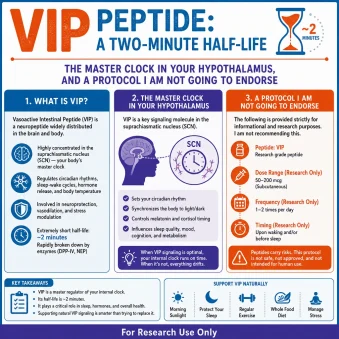
Vasoactive intestinal peptide has a plasma half-life of about two minutes. That one number determines nearly everything about how it can be studied, why every practical formulation is a nasal spray or an inhalation rather than an injection, and why the drug-development history of this molecule is forty years of people trying to make it last longer. It also happens to be the neurotransmitter that keeps the neurons of your master circadian clock in step with each other, which is the part of the story nobody selling it mentions.
Research-use-only disclaimer: VIP supplied as a research chemical is intended strictly for in-vitro and laboratory research use and is not intended for human or veterinary use in that context. Clinical trial results described below concern aviptadil, a separate investigational drug product administered under medical supervision. No dosing or administration guidance appears in this article, and nothing here is medical advice or a treatment claim for any condition.

TL;DR
VIP is 28 residues, in the secretin and glucagon superfamily, signalling through VPAC1 and VPAC2. Its defining property is speed of disappearance: human infusion work found bi-exponential elimination with half-lives of roughly 2 and 21 minutes, and other measurements put blood half-life under two minutes. Everything follows from that. It is why aviptadil, synthetic VIP studied in acute respiratory distress syndrome, is given by continuous infusion or inhalation rather than as a bolus. It is why nasal formulations dominate. And the biology that gets least attention is the most interesting: VIP neurons in the suprachiasmatic nucleus are required for light entrainment and for keeping the master clock's cells synchronised with one another. Research use only.
Structure: 28 residues, secretin and glucagon superfamily.
Receptors: VPAC1 and VPAC2, shared with PACAP.
Half-life: bi-exponential, roughly 2 and 21 minutes. Under 2 minutes in blood.
Circadian: SCN VIP neurons are required for light entrainment and cell-to-cell synchrony.
Clinical: aviptadil studied in ARDS, 196 patients in a phase 2b/3.
CIRS: the protocol exists, the controlled evidence does not.
Status: research use only.
The Name Is Misleading
VIP was isolated from porcine intestine in the early 1970s and named for what it did there: it is a vasodilator and it was found in the gut. Both halves of the name are accurate and together they give a badly wrong impression of what the molecule is.
VIP is a neurotransmitter distributed widely through the central and peripheral nervous systems, and its concentration in the brain and in autonomic nerves matters more to its biology than its concentration in the intestine. It appears in nerve fibres supplying the airways, the vasculature, exocrine glands and the gut, and in specific neuronal populations in the hypothalamus.
Structurally it is 28 amino acids and it belongs to the secretin and glucagon superfamily, which puts it in the same structural family as secretin, glucagon, GLP-1, GIP, GHRH and PACAP. Anyone who has read our retatrutide comparison or the growth hormone secretagogue comparison has met several of its relatives already. They share a common fold and a common receptor class, and that family relationship turns out to matter for the receptor selectivity problem further down.
Two Minutes, and What It Forces
Here is the fact I would put at the top of any VIP product page if it were up to me.
Human infusion studies found bi-exponential elimination with half-lives of approximately 2 and 21 minutes.[1] Other measurements put the half-life of VIP in blood at under 2 minutes.[2]
For comparison, and using numbers from our own secretagogue comparison, sermorelin sits around ten minutes and the DAC-modified analogues reach several days. VIP is at the extreme short end of anything in this catalogue.
Three consequences follow directly and they explain almost every design decision anyone has made about this molecule.
Continuous infusion or nothing, for systemic work. If you want a maintained plasma concentration you have to keep supplying it, which is why the ARDS trials used continuous intravenous infusion. You cannot inject and walk away.
Local delivery becomes attractive. If clearance destroys the molecule before it can travel, put it where you want it. Nasal and inhaled routes place VIP on the target mucosa directly, and the clearance rate stops being the binding constraint because the peptide does not need to survive a journey.
Analogue development becomes the whole game. Forty years of medicinal chemistry on VIP has largely been attempts to extend the half-life, through amino acid substitution, lipidation, micelle formulation and receptor-selective analogues. The comparative lack of a successful long-acting VIP on the market tells you how hard that has been.
Why This Is Harder to Engineer Around Than GHRH
A short section that will interest anyone who read the secretagogue comparison, because it is the same problem with a worse answer.
The GHRH family has a clean story. Sermorelin's half-life is dominated by DPP-IV cleaving between residues 2 and 3. Once you know that, the fix is obvious: protect that bond or attach the peptide to something that keeps it out of reach, which is what the DAC modification does, and the half-life goes from ten minutes to days. One enzyme, one site, one engineering target.
VIP does not offer that. Its rapid clearance is not attributable to a single named protease cleaving at one identified position in the same way, and I have not found a source that makes that claim convincingly. What appears to be happening is a combination of general peptidase activity and rapid distribution and extraction across multiple organs, which is consistent with the bi-exponential profile.
The engineering consequence is that there is no single bond to protect. You are not defending a door, you are trying to make the whole molecule less available to a diffuse process, which is a much harder brief and it is my best explanation for why long-acting VIP analogues have been slower to arrive than long-acting GHRH analogues despite VIP being discovered around the same time.
I hold that explanation loosely. It is inference from the pharmacokinetic shape and the absence of a named enzyme in the literature I have read, rather than something I have seen stated by someone who works on it.
The Suprachiasmatic Nucleus
This is the section I most wanted to write and it does not appear on a single supplier page I have looked at.
The suprachiasmatic nucleus is the master circadian pacemaker in mammals, a paired structure of roughly twenty thousand neurons sitting above the optic chiasm in the hypothalamus. It receives light information from the retina and keeps the rest of the body on schedule.
Two neuronal subtypes dominate it. One expresses arginine-vasopressin. The other expresses VIP.[3]
The VIP neurons do two jobs that the rest of the structure cannot do without them. They are required for light entrainment, meaning the process by which the clock is reset each day by the light-dark cycle. And they are required for synchronising SCN neurons with each other.[3][4]
That second one deserves unpacking because it is the part people find counterintuitive.
Every SCN neuron is an independent oscillator. Each one has a molecular clock running inside it, and each one keeps time slightly differently. What makes the SCN a functioning pacemaker rather than twenty thousand slightly disagreeing stopwatches is that the cells signal to each other and pull into a common phase. VIP signalling through VPAC2 is a central part of that coupling, described in the literature as a cellular pacemaking hub of the circadian circuit.[4]
Remove it and the oscillators do not stop. They desynchronise. The population loses coherence, which is a different failure from the clock stopping and a more interesting one.
The picture is not entirely simple, and the complication is worth stating. Work in adult mice lacking SCN VIP neurons found that circadian locomotor behaviour was retained while daily glucocorticoid rhythms were dampened.[5] So the requirement is not absolute across every output, and the system has more redundancy than the simplest version of the story implies. Different downstream rhythms depend on this signalling to different degrees.
VPAC1, VPAC2, and the PACAP Problem
VIP signals through two class B G protein-coupled receptors, VPAC1 and VPAC2, both coupling primarily to Gs and raising cyclic AMP.
The complication is that VIP does not have them to itself. PACAP, pituitary adenylate cyclase-activating polypeptide, binds VPAC1 and VPAC2 with comparable affinity to VIP, and also binds a third receptor, PAC1, for which it has much higher affinity than VIP does.
So the receptor map is asymmetric. PACAP reaches all three. VIP reaches two of them.
This creates a specific interpretive problem for anyone reading the VIP literature. An effect observed after VIP administration runs through VPAC1 or VPAC2 or both, and separating which one requires selective agonists or knockouts rather than inference. Tissue distribution differs between the two receptors, so which one dominates depends on where you are looking, and a great many papers report a VIP effect without establishing which receptor produced it.
When you see a mechanism claim about VIP, the question worth asking is whether the receptor was identified or assumed.
The asymmetry cuts the other way too, and this is the part that matters if you are designing an experiment rather than reading one. Because PACAP hits VPAC1 and VPAC2 as hard as VIP does, any tissue expressing those receptors is exposed to endogenous PACAP as well. Add exogenous VIP to such a system and you are not switching on a silent pathway, you are adding to a pathway that already has a native agonist working on it. Whether that produces a dose-additive effect, a ceiling effect, or receptor desensitisation depends on the baseline PACAP tone in that tissue, which almost nobody measures.
The receptors also differ in where they sit. VPAC1 is described as the dominant form on many immune cell populations and in lung, while VPAC2 carries the circadian coupling role in the suprachiasmatic nucleus discussed above. So the anti-inflammatory literature and the circadian literature are, to a large extent, describing two different receptors that happen to share a ligand. Treating "what VIP does" as one question is the mistake, and it is the reason claims from one body of work transfer badly to the other.
What It Does in the Tissue It Was Named After
Having spent the article arguing the name is misleading, I should say what VIP actually does in the intestine, because it is not nothing and it connects to work elsewhere in this library.
VIP is released from enteric neurons and drives smooth muscle relaxation and epithelial secretion. It is one of the main inhibitory neurotransmitters of the enteric nervous system, meaning it relaxes gut wall muscle where acetylcholine contracts it, and it stimulates fluid and electrolyte secretion into the lumen.
The clearest demonstration of what that does at scale is a tumour rather than an experiment. VIPomas are rare neuroendocrine tumours that secrete VIP continuously, and the resulting syndrome is severe watery diarrhoea with potassium loss and reduced gastric acid, sometimes called WDHA. It is a natural over-expression experiment, and what it shows is that sustained systemic VIP produces a profound secretory effect on the gut.
I raise it for a reason that has nothing to do with tumours. Any research design that achieves genuinely sustained systemic VIP exposure is pushing toward the physiology that syndrome describes, and the two-minute half-life is, from that angle, doing something protective rather than merely inconvenient. Rapid clearance is why endogenous VIP can act as a local neurotransmitter without producing systemic secretory effects everywhere at once. It is a feature of the design.
There is also a repair story. VIP has been reported to promote secretory differentiation in intestinal epithelium and to reduce radiation-induced intestinal injury in animal work.[8] That is a different kind of gut effect from the secretory one, operating on the epithelium's regenerative behaviour rather than on fluid movement, and it sits alongside the anti-inflammatory literature more comfortably than the VIPoma physiology does.
Gut-directed peptide research is covered elsewhere in this library, including the KPV inflammation reference, which describes a compound reaching the same tissue by a completely different route: transporter-mediated uptake into epithelial cells followed by intracellular NF-kB inhibition, rather than surface receptor signalling from an enteric neuron.
Aviptadil, and What the Trials Did
Aviptadil is synthetic VIP developed as a drug product. The main clinical programme has been in acute respiratory distress syndrome, with the largest activity during COVID-19.
The rationale is anatomically specific. VIP is present at high concentration in the lung, and alveolar type II cells express VIP receptors. Those cells produce surfactant and are a primary target in ARDS. So the argument was that supplying VIP to a lung in respiratory failure supports the cell population whose loss drives the pathology.
A phase 2b/3 multicentre trial enrolled 196 patients with COVID-19 respiratory failure, testing intravenous aviptadil against recovery from respiratory failure and survival at 60 days.[6] A separate inhaled programme ran under the name ZYESAMI.[7]
Reported outcomes across the programme have been mixed and I want to be careful not to overstate them. One study reported a PaO2 to FiO2 ratio improvement of 135.93 against 71.61 for standard of care, p = 0.0218, which is a meaningful oxygenation signal.[6] Aviptadil has not received marketing approval in the United States, which is the relevant summary of where the programme landed overall.
The detail I find most instructive is not the efficacy result. It is the route. Both the intravenous and the inhaled programmes chose delivery methods that maintain exposure over time rather than delivering a bolus. Nobody designing a serious trial of this molecule considered a single subcutaneous injection, and the reason is the two-minute half-life.
Route Selection Matters More Here Than Anywhere
Applying the above to how you would actually run an experiment, which is where this gets uncomfortable for me commercially and I would rather say it than not.
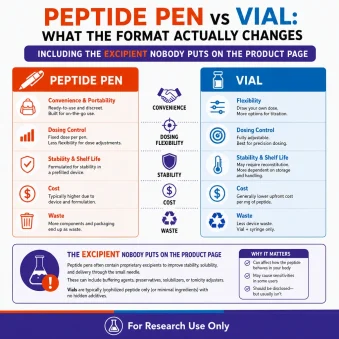
We supply VIP5 as 5mg and 10mg lyophilised vials, as a nasal spray, and as a preloaded autoinjector.
For a molecule cleared in about two minutes, those formats are not interchangeable, and the differences are larger than they would be for almost anything else we sell.
Local mucosal delivery puts the peptide directly on tissue that expresses the receptors, before clearance becomes the limiting factor. For airway or nasal-mucosal research questions, that is the format that matches the biology.
A systemic bolus fights the clearance rate. It produces a brief spike. For a research question about a distant tissue, the honest position is that you should think hard about whether a bolus reaches it at a useful concentration, and design your sampling around minutes rather than hours.
In-vitro work sidesteps the problem entirely, because plasma clearance does not exist in a dish. Nearly all of the receptor pharmacology on VIP was generated this way, and it is why the mechanistic literature is much stronger than the in-vivo literature.
The format question in general, including why a preloaded pen carries excipients a lyophilised vial does not, is covered in the pen versus vial reference.
The Protocol I Am Not Going to Endorse
A large share of the search traffic for this peptide comes from people who found it through a protocol for chronic inflammatory response syndrome, usually attributed to mould or biotoxin exposure. Intranasal VIP is the final step in that protocol. I would be pretending if I wrote an article about VIP and left this out.
What I can tell you accurately:
The protocol was developed largely by one investigator, and the supporting evidence for the VIP component is case series generated within that framework rather than randomised controlled trials run by independent groups. CIRS is not a diagnosis recognised by mainstream medical bodies. There is no controlled trial of intranasal VIP for it that I have been able to find.
What I am not going to say is that the people in this group are imagining things. They report real symptoms, many of them have been dismissed repeatedly, and I have had enough email from them to know that "there is no evidence" is heard as "you are making it up." Those are different statements and the second one is not mine to make.
The accurate version is narrower. The specific claim that intranasal VIP treats a specific syndrome has not been tested to a standard that would settle it. That is a gap in the evidence, and a gap is not a refutation.
There is also a mechanistic reason the idea is not absurd, which is worth stating because dismissing it wholesale would be as sloppy as endorsing it. VIP has documented anti-inflammatory and immunomodulatory activity, and VPAC receptors are present on immune cells. So a mechanism exists by which an anti-inflammatory effect could occur. What does not exist is evidence that it produces a clinical benefit in this population.
If you are running research in this area, the thing that would move the field is a controlled trial. Nobody has run one, and until somebody does, the honest answer is that we do not know.
Where the Evidence Sits
| Claim | Evidence | Strength |
|---|---|---|
| Half-life of roughly 2 minutes | Human infusion pharmacokinetics | Well established |
| Signals via VPAC1 and VPAC2 | Receptor pharmacology | Well established |
| SCN VIP neurons required for entrainment | Mouse genetics and electrophysiology | Strong, with nuance |
| Oxygenation signal in ARDS | Phase 2b/3, 196 patients, mixed results | Moderate, not approved |
| Anti-inflammatory activity | Cell and animal work | Reasonable, mechanism only |
| Benefit in CIRS | Case series, one framework | Untested |
What Research Has Not Established
No controlled trial of intranasal VIP exists for chronic inflammatory response syndrome or for any of the wellness indications it is marketed against.
Whether an observed VIP effect runs through VPAC1 or VPAC2 is unresolved in a great many published studies, because separating them requires selective tools that are not always used.
Whether nasal delivery achieves central nervous system exposure sufficient to reach the suprachiasmatic nucleus is not something I can find an answer to, and it is the question the circadian biology makes most interesting. The SCN sits deep in the hypothalamus, and nose-to-brain transport is a contested area even for molecules studied more thoroughly than this one.
No single named protease has been established as the dominant route of VIP clearance in the way DPP-IV has been for the GHRH family, which is my inference from the absence of such a claim rather than a documented negative.
What is well established: the sequence and family membership, the receptor pharmacology, the pharmacokinetics, and the SCN neuronal requirement for entrainment and synchrony. Those are checkable against the sources below.
How It Is Characterised
VIP is 28 residues, which puts it in a size range where reversed-phase HPLC resolves most related impurities well, and mass spectrometry confirmation is straightforward.
Two specifics for this sequence. VIP carries methionine, which means oxidation is a live degradation route and a stored solution can gain 16 daltons without looking any different, a chemistry covered in the storage reference. And the native peptide is C-terminally amidated, a modification required for full activity at the receptors. A synthesis that produces the free acid instead gives you a molecule one dalton heavier with reduced potency, and a purity figure alone will not tell you which you have.
At PrymaLab, research peptides are characterised with HPLC and mass spectrometry verification and independent third-party testing.
Frequently Asked Questions
What is VIP peptide?
A 28-residue peptide in the secretin and glucagon superfamily, signalling through VPAC1 and VPAC2. Despite the name it is mainly a neurotransmitter rather than an intestinal molecule.
How long does VIP last in the body?
Human infusion work found bi-exponential elimination with half-lives of roughly 2 and 21 minutes, with other measurements putting blood half-life under 2 minutes. That number explains most of the practical decisions made about this molecule.
What does VIP do in the circadian clock?
VIP neurons are one of the two major suprachiasmatic nucleus subtypes and are required for light entrainment and for synchronising SCN neurons with each other. Without that coupling the individual cellular oscillators drift apart.
What is aviptadil?
Synthetic VIP developed as a drug product and studied in acute respiratory distress syndrome, including a phase 2b/3 trial in 196 COVID-19 patients. Delivery was by continuous infusion or inhalation, which follows from the short half-life.
Why is VIP usually supplied as a nasal spray?
Because a molecule cleared in about two minutes cannot practically be delivered as a systemic bolus. Local mucosal delivery puts it on the target tissue before clearance becomes the constraint.
What is the CIRS protocol and is it validated?
Intranasal VIP is the final step in a protocol for chronic inflammatory response syndrome developed largely by one investigator. CIRS is not recognised by mainstream medical bodies and no controlled trial of the VIP component exists. A gap in evidence is not the same as a refutation.
Does VIP get broken down by DPP-IV?
Not in the clean single-enzyme way sermorelin does. VIP's clearance is not attributable to one named protease at one site, which is part of why long-acting analogues have been slow to arrive.
Is VIP approved for human use?
No. Research use only. Aviptadil is a separate investigational drug product without US marketing approval.
References
- Vasoactive intestinal peptide in man: pharmacokinetics, metabolic and circulatory effects. PubMed 730072. Source for bi-exponential elimination with half-lives of approximately 2 and 21 minutes.
- Infusion of vasoactive intestinal polypeptide in man: pharmacokinetics and effect on gastric acid secretion. PubMed 16435487
- Suprachiasmatic VIP neurons are required for normal circadian rhythmicity and are comprised of molecularly distinct subpopulations. PMC7468160
- The VIP-VPAC2 neuropeptidergic axis is a cellular pacemaking hub of the suprachiasmatic nucleus circadian circuit. PMC7341843
- Adult mice lacking VIP SCN neurons retain circadian locomotor behavior but exhibit dampened daily glucocorticoid rhythms. bioRxiv preprint
- The use of IV vasoactive intestinal peptide (aviptadil) in patients with critical COVID-19 respiratory failure: results of a 60-day randomized controlled trial. Crit Care Med. 2022. Critical Care Medicine
- Inhaled ZYESAMI (aviptadil acetate) for the treatment of severe COVID-19. NCT04360096
- Vasoactive intestinal peptide promotes secretory differentiation and mitigates radiation-induced intestinal injury. PMC11462795
Clinical results are summarised from published reports and should be verified against the primary publications. Reference 5 is a preprint at the time of writing. Status current as of 19 August 2026.
Final disclaimer: This article is an educational research reference. VIP supplied by PrymaLab is sold and studied for laboratory research use only and is not approved by any regulatory authority for human or veterinary use. Statements have not been evaluated by the FDA. Nothing here is medical advice, administration guidance, or a treatment claim for acute respiratory distress syndrome, chronic inflammatory response syndrome, mould illness, circadian disorders or any other condition.
Clinical trial results described above relate to aviptadil, a separate investigational drug product administered under medical supervision, and do not describe or support any use of research-grade material. Always verify the legal status of any research compound in your jurisdiction before purchase or use.